Projects · Mini Hostpapa
Governance, Risk & Compliance
ISO intent, physical security, SSDLC, and active cyber defense for HostKid: governance at executive level, not checkbox theater.
Governance, Risk & Compliance
Alright. Let's talk about the question that shows up in every serious RFP:
"Are you ISO certified?"
Before anyone asks that out loud, we need to answer the harder one internally:
"Do we actually behave like a company that could pass an audit, or do we just have a slide that says security?"
This doc is Volume 0 for GRC. Scope, risk appetite, ISO alignment, physical security, secure SDLC, and something I care about personally: we do not stop at locking doors. We measure whether people and systems still behave under pressure, and we watch attacks in real time so we learn faster than the next incident teaches us the hard way.
Here: intent, frameworks, habits, and where proof lives.
Volume 22 (Security): controls, tooling, hardening playbooks.
Volume 27 (Production operations): change advisory, DR tests, incident muscle.
Volume 18 (Logging): audit trails and retention that auditors actually read.
Full disclosure: I am, at core, a security person. GRC is not paperwork I tolerate so engineering can ship. It is how a hosting company earns the right to hold customer DNS, billing data, and platform access. HostKid documents that posture before we have a certificate on the wall.
Why a mini host still needs GRC thinking
HostKid holds:
- Customer credentials and data
- Billing and identity information
- DNS (mistake equals outage or hijack)
- Email (abuse potential and deliverability reputation)
- Physical access to the gear that runs the factory floor
Even a lab company documents how it would behave at production maturity. That is the DevSecOps instinct: traceable decisions, not "we will secure it later."
You can align with ISO/IEC 27001 without paying for certification on day one. The value is the ISMS mindset: identify assets, assess risk, apply controls, prove they work, review on a cadence. Certification is evidence that an external party agrees you were not lying to yourself.
ISO 27001 is the spine (everything else hangs off it)
| Framework | What it gives us | HostKid use |
|---|---|---|
| ISO/IEC 27001 | Information Security Management System (ISMS) | Primary alignment target. Scope, control map, risk register, management review. |
| ISO/IEC 22301 | Business continuity | DR, backup strategy, restore drills. Volume 27. |
| ISO/IEC 20000 | IT service management | Support, change, incident process. Volumes 23, 27. |
| SOC 2 (Type II) | Trust for B2B buyers (US-heavy) | Future if we sell to SaaS/agencies at scale |
ISO is not a PDF binder. It is a loop: assess risk → pick controls → operate them → measure → fix gaps → repeat. If a control exists only in Notion, it does not exist.
Physical security (the rack is in scope)
People love to talk about zero trust in Kubernetes and forget the datacenter door.
For HostKid, physical controls are first-class ISO themes, not a footnote:
| Control area | Executive intent | Proof we expect |
|---|---|---|
| Facility access | Only authorized people touch racks, keys, and remote hands tickets | Access logs, visitor policy, escort rules where colo requires it |
| Asset handling | Servers and disks are tracked from purchase to decommission | Asset register, wipe certificates before resale or scrap |
| Network perimeter | Firewall, segmentation, out-of-band management not exposed to the internet by accident | Diagram + rule review. Volume 5, Volume 22. |
| Environmental | Power, cooling, and cable discipline are availability and safety | Colo SLA, capacity planning in Volume 27 |
If someone can walk off with a disk or plug a rogue device into your management VLAN, your portal MFA story does not matter. We treat colo + rack + OOB as part of the ISMS scope, not "the datacenter team's problem."
Secure SDLC (SSDLC): build security in, do not bolt it on
HostKid ships software: portal, APIs, provisioning engine, automation. Secure SDLC means security is a gate in the pipeline, not a panic meeting the week before launch.
| Phase | What we enforce (executive level) | Handbook home |
|---|---|---|
| Design | Threat sketch for new flows (auth, billing webhooks, provision jobs) | Vol 0 architecture, Vol 20 APIs |
| Build | Dependency scanning, secret scanning, code review with security checklist | Vol 21 automation, Vol 22 |
| Test | SAST/DAST where appropriate, staging that mirrors prod auth and TLS | Vol 22, Vol 27 |
| Deploy | Signed artifacts, GitOps, no manual prod SSH as default path | Vol 7 IaC, Vol 21 |
| Operate | Patch cadence, vuln SLAs, logging, incident hooks | Vol 17, 18, 27 |
No feature ships because "it works on my laptop." It ships when we can answer: who can abuse it, what breaks if it fails, and what log proves who did what.
AI velocity vs code quality (we are not anti-AI, we are anti-trash)
Let me say this plainly because the industry is split into two useless camps right now.
Camp one: "Never use AI, real engineers type every line." That is nostalgia, not strategy.
Camp two: "Ship faster, vibe-code everything, fix security later." That is how you get a portal that demos beautifully and explodes in production because the base layer had SQL injection, hardcoded secrets, and copy-paste auth logic nobody read.
HostKid is in camp three:
Use AI as a productivity multiplier. Never use AI as an excuse to skip engineering discipline.AI compresses time to market. That is real. You can scaffold APIs, tests, Terraform modules, and boilerplate in hours instead of days. But the same tool can produce massive volumes of plausible garbage: spaghetti architecture, inconsistent patterns, subtle vulnerabilities baked into "working" code, and dependencies nobody audited because the diff was too long to review with human eyes.
Fast code is not good code. Productivity that outputs weak security is negative productivity. You saved a sprint on the keyboard and spent a quarter on incidents, rework, and trust repair.
We are not refusing the mindset of coding with AI. We are refusing the fantasy that generation replaces governance. The how is SSDLC enforced end to end, from architecture to commit, with automated gates that fail the pipeline when quality or security regresses.
The guardrails (architecture → commit → prod)
| Stage | What AI must not bypass | Enforcement examples |
|---|---|---|
| Architecture | Threat sketch, data flow, trust boundaries before "generate the service" | ADR or design note linked in MR. Vol 0 + Vol 20 sign-off for sensitive flows |
| Local / pre-commit | Secrets and obvious foot-guns never enter Git | Gitleaks, lint, formatter, unit tests on changed paths |
| Merge request | Human review on security-sensitive diffs, even if AI wrote 90% | CODEOWNERS, checklist: auth, input validation, logging, error handling |
| CI pipeline | Static analysis, dependency risk, container hygiene | SonarQube (quality + security hotspots), SAST (Semgrep/Trivy as needed), SBOM, license checks |
| Staging | Behavior matches prod TLS, auth, and config | DAST on exposed routes, integration tests, provision smoke paths |
| Prod promotion | ISO-aligned release evidence, not "green button because demo worked" | Change record, rollback plan, vuln SLA clear, signed artifacts / GitOps only |
SonarQube (and peers) are not vanity metrics. Complexity spikes, duplicated logic, uncovered security hotspots, and dependency drift are early warnings before exploit Wednesday. We treat quality gates like firewall rules: fail closed. No "temporary override" without documented exception and expiry.
AI writes drafts. Engineering owns merges. The person accepting the MR is accountable, not the model. If you cannot explain what the code does under audit, it does not ship, no matter how fast it was generated.
What we explicitly reject
| Anti-pattern | Why it dies here |
|---|---|
| 10k-line AI dump, zero review | Unreviewable attack surface. Split, review, test, or delete. |
| Skipping tests "because AI added them later" | Later never comes. Tests gate the merge. |
| Disabling SonarQube / SAST to go green | Documented exception only, with owner and expiry. |
| Prod hotfix outside GitOps | Speed without traceability is how base code gets exploited quietly. |
| "Security will harden in Volume 22" | Volume 22 implements. Volume 0 and SSDLC block weak code at the door. |
I have shipped SSDLC at scale before: SonarQube in CI, pre-commit secret scanning, SAST/DAST, centralized findings. HostKid inherits that bias. AI makes you faster at typing. SSDLC makes you safe enough to run a hosting company. Both. Always.
Pipeline templates, tool versions, and MR checklists: Volume 21 (Automation) and Volume 22 (Security). This section states the executive rule: productivity without quality is debt with a chatbot face.
The security department never stops learning (and we test people on purpose)
Policies on a wiki do not equal culture. HostKid's security posture assumes humans are part of the attack surface and training decays the moment life gets busy.
We run deliberate exercises, not annual checkbox videos. Examples we intend to use:
Phishing simulations: send a controlled test email. Measure who reports it, who clicks, who forwards it to the team without opening attachments.
Tabletop incidents: "Portal admin creds leaked on paste site" walkthrough with support + engineering.
Access reviews: quarterly proof that ex-contractors and old API keys are gone.
Control fire drills: restore from backup, fail over DNS, rotate a leaked webhook secret.
The goal is not shame. The goal is signal: where do we need better tooling, clearer runbooks, or one more hour of practice?
If nobody fails a simulation, the simulation was too easy. We want a department that treats learning and being tested as normal ops, the same way we treat patch Tuesday.
Securing alone is not enough: see attacks while they happen
Here is the mindset shift I keep pushing:
Hardening without visibility is hope.You can patch, segment, MFA everything, and still get surprised because the internet is loud. Attackers scan constantly. Bots hammer SSH. Credential stuffers hit login forms. Mail abuse probes exist 24/7.
A mature host does two things in parallel:
- Prevent what we can (controls, SSDLC, physical security, identity).
- Observe what still reaches the edge, classify it, and feed dashboards leadership and engineering actually open.
That second lane is why Executive metrics & SLOs and this GRC doc shake hands. Metrics are not only revenue and provision time. They include attack volume, top source countries, alert categories, and whether our detections are getting smarter.
Cyber deception: after we secure, we deliberately bait
Passive defense is necessary. It is not sufficient.
Once baseline controls exist, HostKid adopts cyber deception: honeypots, canary tokens, and decoy surfaces that look real to attackers but exist only to generate intelligence. Every touch becomes a lesson: new scan pattern, new exploit attempt, new malware sample, new geo trend.
Cyber deception is the practice of planting fake assets (services, credentials, files) that legitimate users never touch, but attackers do. Instead of only blocking, you lure, log, and learn. Think mazes and canaries, not just higher walls.
I wrote a practical intro carousel on this mindset on LinkedIn: The art of cyber deception.
Defense alone is no longer enough. Attackers only need to be right once. Deception turns their curiosity into our telemetry.
T-Pot CE: our honeypot platform of record (lab → production path)
For the deception layer, we standardize on T-Pot CE from Deutsche Telekom Security: an all-in-one, multi-arch multi-honeypot platform that runs 20+ honeypot personalities behind Docker, feeds the Elastic Stack, and ships visualization tooling out of the box.
Why T-Pot for HostKid:
| Reason | What it gives us |
|---|---|
| Breadth | Cowrie, Dionaea, Conpot, Honeytrap, and many others in one compose stack |
| Visualization | Elastic Stack dashboards plus live attack map options |
| Operational fit | Docker-native, matches how we already think about platform services |
| Threat intel loop | Feeds IoC lists, firewall rules, and Volume 22 detections over time |
T-Pot is a honeypot. It is designed to be attacked. Isolate it on a dedicated VLAN or host, never co-mingle with production management planes, and treat compromise of the honeypot as an expected operating condition, not a surprise. Read upstream guidance before you expose ports.
Executive rollout phases:
- Lab T-Pot on isolated hardware: validate resource needs (plan for 8 to 16 GB RAM, 128 GB disk, open outbound internet for updates).
- Dashboards wired into our monitoring story (Volume 17): attack categories, source countries, top ports targeted.
- Playbooks: when a novel pattern spikes, who gets paged, what gets blocked at the edge, what gets ticketed for Volume 22.
- Production deception mesh: multiple sensors, not one lonely VM, aligned with ISO incident management themes.
Implementation detail lands in Volume 22. This page states why it exists and that it is mandatory direction, not a cool GitHub project for weekends.
Live attack monitoring (what "good" looks like on screen)
Until our own T-Pot and SIEM dashboards are fully wired, we still hold the bar visually: leadership should be able to open one view and see the noise on the wire, not guess.
The screenshot below is Sicherheitstacho (Deutsche Telekom Security's public attack-speedometer style view): real-time attack arcs on a world map, alert categories in the last 60 seconds, source and target country rollups, and a live alert feed. It is the vibe we want internally: attacks listed, categorized, geolocated, and scrolling, not buried in raw syslog.
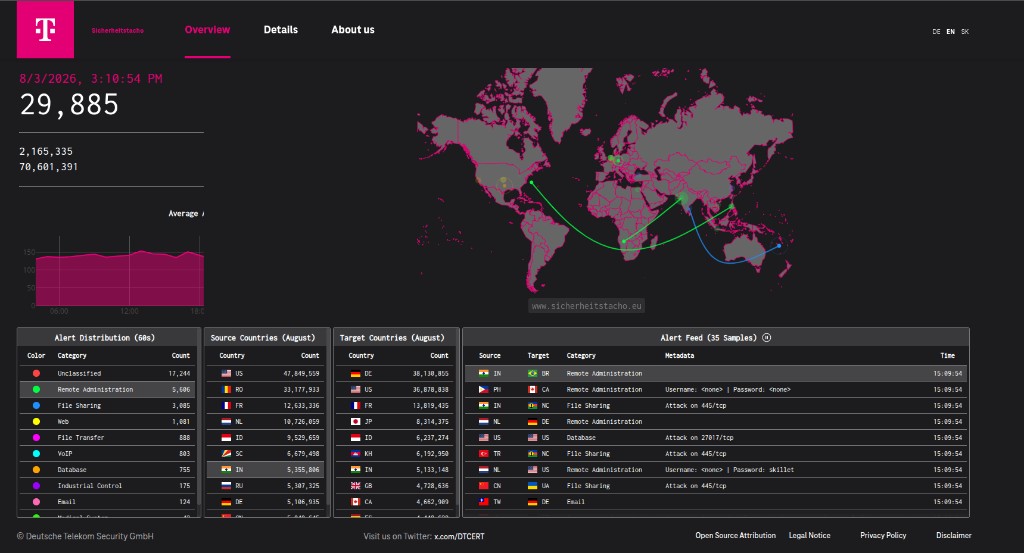
If you cannot show me today's attack picture, you are not ready to tell a customer you are "monitoring 24/7." T-Pot gets us there. Grafana and Loki get us platform health. Together they answer what is hitting us and what is breaking us.
ISMS scope (draft)
In scope (HostKid):
- Customer portal and APIs
- Provisioning engine and automation pipelines
- CloudStack management plane and hypervisor hosts
- DNS, email, billing integrations
- Monitoring, logging, backup systems
- Support tools and knowledge base
- Physical colo footprint and rack assets
- Deception infrastructure (T-Pot and successors)
- People processes: onboarding, offboarding, security exercises
Out of scope (initially):
- Customer content inside VMs (customer responsibility; see Security posture)
- Third-party registrar internals (supplier risk only)
Scope gets a formal statement before any real certification attempt.
Risk appetite (executive)
| Area | Appetite | Rationale |
|---|---|---|
| Platform outage | Low | Core revenue driver |
| Data breach (our systems) | Very low | Existential trust hit |
| Undetected attack activity | Very low | We deploy deception + monitoring to shrink this |
| Provisioning delay | Medium-low | SLO-backed, not zero |
| Experimental features in prod | Low | Use lab/staging |
| Vendor dependency | Medium | Document supplier risk |
| Failed phishing simulation | Medium (managed) | Expected; drives training, not blame |
Risk register (format)
Every serious host maintains a register. Our columns:
| Field | Example |
|---|---|
| Risk ID | R-2026-014 |
| Description | Compromised admin portal account |
| Impact | High. Customer data exposure |
| Likelihood | Medium |
| Owner | Security / founder |
| Mitigation | MFA, RBAC, audit logs, deception intel (Vol 9, 22) |
| Residual risk | Low after controls |
| Review date | Quarterly |
Living register grows in Volume 22; executive template lives here.
ISO 27001 control mapping (executive)
Map themes to handbook volumes. Implementation detail elsewhere:
| ISO 27001 theme | Executive intent | Handbook home |
|---|---|---|
| Organizational controls | Policies, roles, supplier risk, management review | Vol 0, 27 |
| People controls | Hiring/termination hygiene, awareness, phishing exercises | Vol 0, 9 |
| Physical controls | Colo access, asset lifecycle, rack security | Vol 27, Vol 22 |
| Technological controls | Crypto, logging, vuln mgmt, backup, SSDLC | Vol 22, 18, 17, 21 |
| Access control | Least privilege, MFA, SSO | Vol 9, 22 |
| Operations security | Change mgmt, capacity, malware, honeypots / deception | Vol 21, 27, 22 |
| Incident management | Detect, respond, learn, attack dashboards | Vol 23, 27, 17 |
| Business continuity | Backups, DR tests | Vol 6, 27 |
| Supplier relationships | Registrar, payment gateway, upstream, colo | Vol 0, 11 |
When you implement something in Volume 22, ask: which ISO theme does this satisfy? When an auditor asks a question, jump to the volume that proves behavior, not a slide that says "we care about security."
Governance habits
- Quarterly risk register review with deception and exercise results on the agenda
- Change advisory for production platform (lightweight at first; Volume 27)
- Documented exceptions with expiry dates (temporary risk accepts are not permanent folklore)
- Supplier review when billing, DNS, registrar, or colo vendors change
- Security exercise calendar: phishing tests, tabletops, restore drills (at least one meaningful test per quarter)
- Attack dashboard review: monthly leadership glance at T-Pot / SIEM rollups alongside executive metrics
What this doc does not cover
| Topic | Where it lives |
|---|---|
| Vault policies, firewall rules, CrowdSec | Volume 22 |
| T-Pot install YAML, VLAN IDs, honeypot tuning | Volume 22 |
| Audit log retention config | Volume 18 |
| Pen test reports | Future ops doc / Volume 27 |
| Customer-facing trust copy | Security & trust posture |
The GRC stack in one breath
Lock the factory floor. Build software like attackers exist. Train people until the training shows up in simulations. Deploy honeypots. Watch the wire. Map every control to ISO. That is HostKid GRC in practice, not a compliance costume.
Next: Security & trust posture. Customer promise and shared responsibility.