Projects · Mini Hostpapa
Organization & Departments
Who owns what at HostKid. Clear scopes, team boundaries, communication handoffs, and People Ops that stays aligned with the company.
Organization & Departments
Perfect CloudStack doesn't save you if nobody knows who owns the rack, the portal, or the invoice.
This doc is the org map: departments, hard scope boundaries, and how teams talk to each other. Even when one person wears five hats in the lab, the hats stay separate so we don't mix who decides with who executes.
Culture and values live in Executive Overview. This doc is the operating structure behind those values.
Organization map
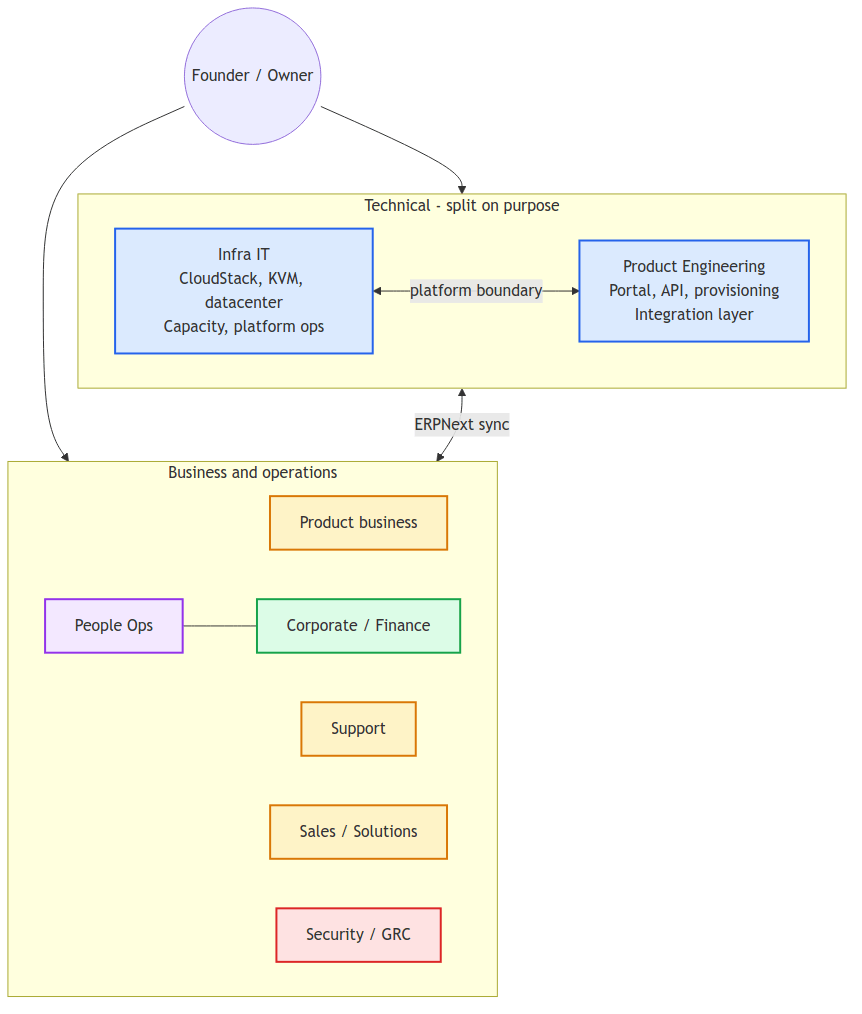
Departments at a glance. Technical teams are split on purpose. People Ops stays aligned with Corporate at small scale, not a separate empire.
Two technical teams (don't merge them)
Most hosting org fights start here: one blob called "Engineering" that owns everything from cable pulls to React components. We split it.
Infrastructure & Datacenter (Infra IT)
Charter: Keep the datacenter and CloudStack platform healthy, secure, and within capacity.
| In scope | Out of scope |
|---|---|
| On-site datacenter work: power, hardware, cabling, physical access | Portal UI, customer-facing product logic |
| CloudStack: zones, hosts, storage, network underlay, offerings (platform side) | ERPNext business rules, tax, payroll |
| KVM health, templates, capacity, patching, backups, DR for the platform | Sales promises, custom SLAs in contracts |
| Monitoring/logging for infrastructure (with Ops practices) | Application bugs in portal/API code |
Decides: change windows, capacity limits, when we stop selling VPS in a zone, how CloudStack is run.
Handbook: Volumes 3–7, 17–18, 27.
Product Engineering (solution stack)
Charter: Build and run what customers and staff use: portal, API, provisioning engine, integrations.
| In scope | Out of scope |
|---|---|
| Frontend, backend, REST/API, provisioning workers and queues | Rack installs, switch firmware, physical security of the building |
| Portal ↔ ERPNext ↔ CloudStack integrations | CloudStack cluster surgery (Infra IT owns the platform) |
| Internal k8s apps (admin tools, monitoring hooks, internal services) | Interpreting HR policy or handling billing disputes |
| CI/CD for application repos, API contracts, developer experience | DNS/email product operations (later product lines, other volumes) |
Decides: app architecture, release cadence for portal/API, how the provisioning engine behaves.
Scope can grow later: reseller API, migration wizards, mobile app, AI-assisted support tools. That expansion gets documented. It is not silent scope creep.
Handbook: Volumes 8–10, 19–21.
Boundary rule: Infra IT owns the factory floor. Product Engineering owns the software that runs orders through the factory. CloudStack down → Infra IT leads. Paid but not provisioned → Product Engineering leads (Corporate + Infra consulted).
Other departments (short charters)
| Department | Owns | Does not own |
|---|---|---|
| Product (business) | SKUs, pricing, roadmap, definition of done for what we sell | Implementing CloudStack or shipping portal code |
| Corporate / Finance | ERPNext: billing, finance, people records, Frappe Insights cockpit | Production changes on CloudStack or portal |
| Support | Tickets, onboarding help, status comms, KB | Changing production without the change process |
| Sales / Solutions | Discovery, deals, migrations, partner scope | Committing infra or features without Product + Infra sign-off |
| Security / GRC | Policy, risk register, compliance scope, access standards | Running the ticket queue or owning day-to-day ops |
People Ops: avoid the HR gap
In a lot of companies HR becomes the problem: gatekeeper culture, policies nobody read, rules that don't match how the work actually runs. We don't want that.
HostKid treats people work as People Operations, handbook-first, aligned with Executive Overview values. Same inspiration as GitLab's public handbook: people policies live next to engineering and finance docs, not in a separate empire.
This is not a rejection of HR. It is an enhancement: clearer process, handbook-first culture, and a better environment for how the company actually runs. Many HR professionals already work this way without the "People Ops" label. The full paradigm, respectful to HR, with real situations and how each model responds, is in the blog: People Ops, not traditional HR.
| People Ops does | People Ops does not |
|---|---|
| Hiring process, contracts, leave, documented people policies in ERPNext/handbook | Override department accountability or technical roadmap |
| Facilitate fair process when values or policy are in question | Block hires or promotions on vague "culture fit" without written criteria |
| People metrics in Insights (retention, time-to-hire), not surveillance | Own incident response or customer provisioning |
Executive rules:
- Every people policy passes the respect test: would a senior infra engineer read it and feel treated like an adult?
- Disputes escalate through documented process + values, not hallway politics.
- At small scale, People Ops may be Corporate (ERPNext) + founder + handbook. The model still matters before headcount.
Department handoffs (visual)
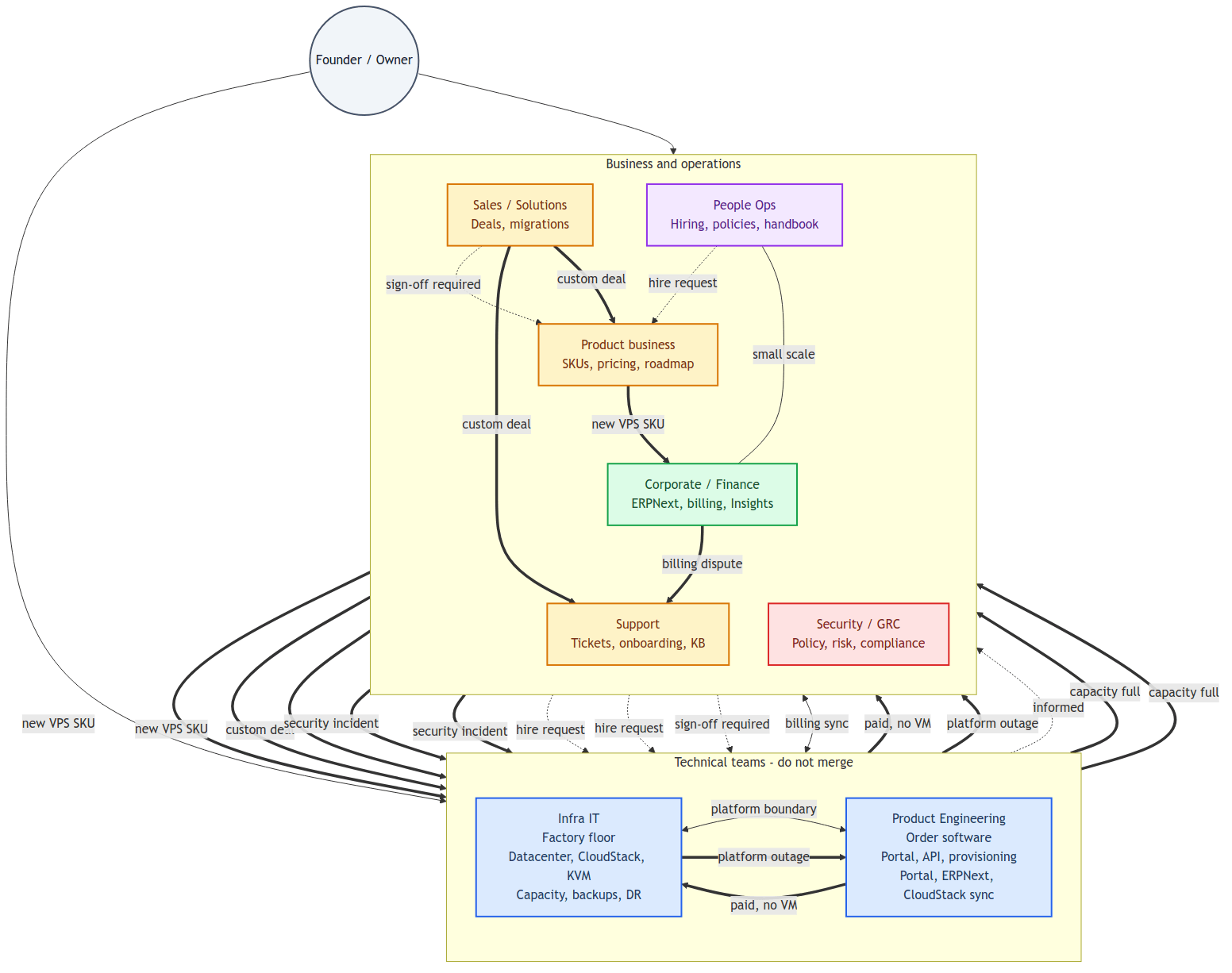
How teams connect in practice. Matches the handoff table below.
| Arrow | Meaning |
|---|---|
| Thick arrow | Who leads that handoff |
| Solid arrow | Ownership, integration, or primary data flow |
| Dotted arrow | Consult, advisory, or informed |
| Bidirectional | Two-way sync (billing, platform boundary) |
How teams communicate (handoffs)
Default: async and written. Ticket, handbook section, or ERP record. Not "we talked in a call and forgot."
| Situation | Lead | Consult | Artifact |
|---|---|---|---|
| Customer paid, no VM | Product Engineering | Corporate, Infra IT | Ticket + job ID + ERP order ref |
| CloudStack / datacenter outage | Infra IT | Security, Product Eng | Incident doc, status update |
| New VPS SKU | Product (business) | Corporate, Product Eng, Infra IT | SKU spec, ERP item, CloudStack offering |
| Capacity full in a zone | Infra IT | Product, Corporate | Capacity note in Insights / internal doc |
| Billing dispute / refund | Corporate | Support | ERPNext case, not a Slack DM |
| Custom deal / migration | Sales / Solutions | Product, Infra IT, Support | Solution design (Volume 25) |
| Security incident / abuse | Security / GRC | Infra IT, Product Eng | Incident + runbook |
| Production change (any layer) | Owner of that layer | Infra or Product Eng as needed | Change ticket, not cowboy deploy |
| Hire / role request | Department lead | People Ops / Corporate | Role description, handbook-aligned |
No custom infra promise on a call without Solutions + Product + Infra loop. Even if the founder is all three today, run the loop anyway. Build the habit.
RACI (who is accountable)
| Activity | Responsible | Accountable | Consulted | Informed |
|---|---|---|---|---|
| Platform outage | Infra IT | Infra lead / founder | Security, Product Eng | Support |
| Portal/API outage | Product Engineering | Product Eng lead / founder | Infra IT | Support |
| New VPS SKU | Product (business) | Founder / product owner | Corporate, Product Eng, Infra IT | Sales |
| Provision pipeline bug | Product Engineering | Product Eng lead | Infra IT, Corporate | Support |
| ISO scope change | Security / GRC | Founder | Infra IT, Product Eng | All leads |
| Major customer migration | Solutions | Solutions + customer | Infra IT, Support, Product Eng | Corporate |
Accountable = one person. Not a committee.
Team size stages
Stage 1 (lab): One person, many hats. Docs still split scopes so habits don't rot.
Stage 2 (5–15): Infra IT and Product Engineering are different people. On-call exists. Corporate is not "whoever checks email."
Stage 3 (15+): Security/GRC touch formalized. Capacity planning is routine. Sales cannot bypass the handoff table.
More on platform vs stream teams: reading shelf, Volume 25.
What this doc does not cover
- Incident runbooks → Volume 23, 27
- RBAC and tooling → Volume 9, 22
- ERPNext module setup → Volume 11, Corporate
Next: Core values & human engine. Values, LMS, fair evaluation, and scenario training.